
- News
- 'There is still a denial of voices of colour, in literature and in films '
This story is from January 24, 2016
'There is still a denial of voices of colour, in literature and in films '
Marlon James is something of a rockstar-writer, an aura that's grown since he won the Booker Prize last year for A Brief History of Seven Killings, which placed singer Bob Marley at the heart of Jamaican political intrigue of the 1970s. The writer tells Joeanna Rebello why questions of race and language run through his narrative veins
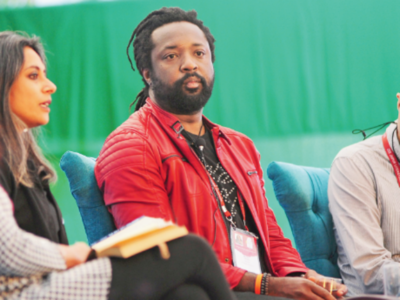
Marlon James is something of a rockstar-writer, an aura that's grown since he won the Booker Prize last year for A Brief History of Seven Killings, which placed singer Bob Marley at the heart of Jamaican political intrigue of the 1970s. The writer tells Joeanna Rebello why questions of race and language run through his narrative veins
You've called out racism in films, society and politics.
Have you encountered it in publishing?
For me, no. I've always had open-minded and fearless publishers, who've been committed to diversity and voices of colour. But there are still narrow perceptions of what people read and want in fiction. We still have this idea that the reader of colour doesn't read literary fiction. It's racist to think black people are only going to read a certain type of literature. Racism is not malevolent but systemic, and if you think of it like this a whole other view comes to fore. There's a huge underestimation of the reader and writer of colour. Publishers will typically ask a writer to insert a sympathetic white character. I wasn't asked to, but I got a lot of pleasure subverting it. The white characters in my books are three-dimensional and real, but also a little clueless. Nobody was going to come to save the Jamaicans in my book. But I will have them try. I did however pay the price for writing the stories I did. My first novel was turned down by almost every publisher in the US because they thought there was nothing in the story anyone in America could identify with.
We're still dealing with a denial of voices of colour, not only in literature but in films too — like the #OscarsSoWhite thing. Will Smith's boycott of the Oscars has people saying he's just mad because he didn't get nominated for Concussion, but black people can have more than one thought at the same time, people! We think racism is Uncle Bubba, the redneck lynching black people, but no.
I don't know if I can be fully myself there, but that is a loaded answer, because there are quite a few queer people in Jamaica who are living full lives...granted a lot of them are protected by class. We did have a pride this year, but it was basically a flash mob. On the one hand, I thought it was a huge step, but on the other, I thought, you had to come out, flash your rainbow flags, stay for 60 seconds, jump in a car and vanish. And make sure you have an exit because if you get blocked, you'll have a mob in 10 seconds. So on the one hand it's great we had an open-air pride, but on the other hand we're living in such fear, we have to vanish. It's a sign of progress and it would be a good thing if I believed in progress, but I don't. I believe that progress lets people off the hook. People say we've made progress with racism; I say you're not supposed to make progress with racism, you're supposed to stop being racist. You're not supposed to make progress on homophobia, you're supposed to stop being homophobic. You're not supposed to make progress on sexism, you're supposed to stop raping women. It's not incremental, you should stop it now; we should have a law that makes you stop it. We can change a law before we change an attitude.
The book has been likened to a Tarantino film for its graphic violence. You've talked about the inadequacy of art — photography, novel, film — as narrative mediums for atrocity. How else is one to recount it? Through reportage?
No, I still try to recount it in my book. This will be a debate I will never resolve. We have to consider what exactly we mean when we write beautiful prose about ugly things. But then we enter this quagmire of what is ugly prose, what is violent prose. I think sometimes aesthetics gives us a way to ignore the socio-cultural. I think we have to approach those scenes with care. As loud as I write, I'm not reckless when I write of violence. I'm super explicit, but not reckless, which to me would be a pornography of violence. When I wrote my novel about slavery, if for example, there was a whipping every five pages, we're no longer horrified by it, we become numb. I think pretty prose and an over-reliance on melodrama can disengage us from violence.
Your book is written largely in Jamaican patois. How do you view language in the context of cultural identity and globalization?
Language is identity. Although language is always shifting and growing; it is dynamic. Any attempt to standardize it will fail, because language doesn't work that way. Even at those times in my life when I thought that meant an inferior identity. That denying language or speaking standard English means that I am smart. Knowing when and where to use my Jamaican patois shows that I have some sort of judiciousness. There's no such thing as standard or proper English. It's the last way in which we're voluntarily oppressing ourselves. I don't speak English as if it's such a grand privilege to be able to speak in the master's tongue. Language is here to serve you, not the other way around.
End of Article
FOLLOW US ON SOCIAL MEDIA

Hot Picks
TOP TRENDING
Popular Categories
Hot on the Web
Top Trends
IND vs NZ Live ScoreMike JeffriesVande Bharat SleeperTaylor SwiftCyclone Dana LiveMaharashtra ElectionBengaluru Building CollapseIsrael Hezbollah War NewsBrics Summit 2024CBSE Date Sheet 2025Brett LeeLawrence BishnoiStudy AbroadDelhi AQI TodayMaharashtra Election ScheduleJharkhand Election ScheduleLive Cricket Score
Trending Topics
Diwali WishesDhanteras 2024Vettaiyan CollectionDiwali 2024 DateAhoi Ashtami 2024Venom ReivewBigg Boss 18Vicky Vidya Ka Woh Wala Video CollectionSalman KhanRon Ely Death NewsBelly FatPapayaSalman KhanPataudi PalaceActor Bala Wedding NewsGheeDiwali Bank HolidaysDhanvantariFc Barcelona Vs Bayern MunichWordle Answer
Living and entertainment
Latest News
Bomb threats to airlines: Why IT ministry is upset with Elon Musk's TwitterSoaked figs vs soaked dates: Which is healthier for you?8 reasons Indians add ghee in dal and why it should be added in soups too2nd ODI: Charith Asalanka stars as Sri Lanka defeat West Indies by 5 wickets, clinch seriesOmar Abdullah meets Amit Shah amid J&K terror hits, may call on PM tooWho is Stacey Williams? Ex-model who accused Trump of groping herNo floor price for non-basmati rice exports as government lifts curbsEurope’s satellite disintegrates in crucial geo orbit, draws flak from Russia for adding to space junkCongress declares list of seven candidates for Rajasthan by-electionsEating this fruit can make you a non- vegetarian?Tyreek Hill and Wife Put Lavish $9.6M Florida Mansion on Market—Is a Trade Next?‘Bougainvillea’ box office collections day 7: Kunchacko Boban starrer nears Rs 30 croresEvidence shows 3000 North Korean troops in Russia, possibly for Ukraine war: USUnni Mukundan’s ‘Marco’ Hindi teaser to be unveiled by John AbrahamSwiggy follows Zomato, increases Platform fee by 60%, but this may be the 'big difference'Retrograde Realities: How Planetary Retrogrades Affect Your Astrological ChartCivic agencies take up cyclone Dana preparationsWho is Nas Daily? Palestinian-origin vlogger who lost followers for supporting Israel
Copyright © 2024 Bennett, Coleman & Co. Ltd. All rights reserved. For reprint rights: Times Syndication Service